FP054

Bootc in Production: What It Actually Looks Like | Fedora Podcast Ep. 054

Episode 54 of the Fedora Podcast is out, and this one digs into something I am genuinely curious about for my own homelab: what does bootc look like when someone is actually running it day to day, not just kicking the tires?

https://youtu.be/6_ZzEIvNySc

James Harmison joined me to walk through how he uses bootc across a pretty wild range of contexts, from his personal laptops and a stripped-down SteamOS-style couch gaming rig, to swapping kernels in OpenShift for AMD GPU support at work. His setup replaces the traditional dotfiles repo entirely, bakes kernel modules directly into the image so DKMS and akmod are completely gone, and runs CI on his homelab to rebuild the image on every commit. It is the kind of thing that sounds overcomplicated until he explains it, and then it sounds like the only sane way to manage a system.

We also spent time on Chunkah, an upstream project working on smarter container image chunking for bootc. James was one of the first people to stress test it on a large image and found some real problems with the packing algorithm. He helped kick off the conversations that are now shaping the next release. That is the kind of quiet upstream contribution that does not always get attention but genuinely moves the project forward.

If you are curious about bootc and want to hear from someone who has been living in it for a couple of years, this episode is a solid starting point.

Listen to the full episode on the Fedora Podcast: Bootc in the Wild | Episode 054

This is the kind of conversation that fits right in the middle of my broader interest in where Linux infrastructure is heading, both for homelabs and production environments.

GPU-Ready AI on Azure

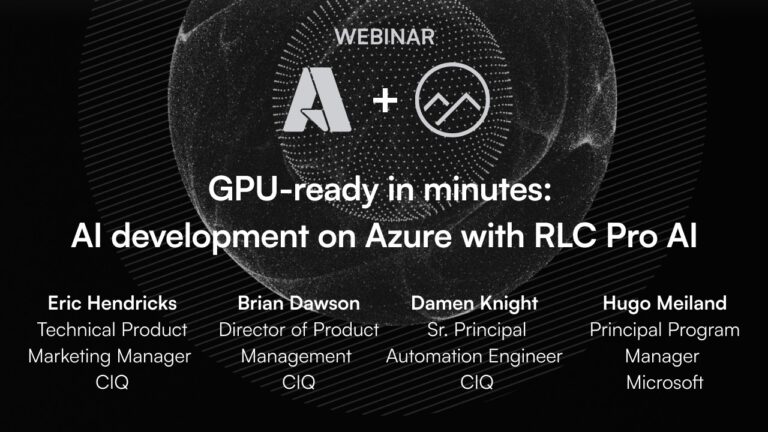
GPU-Ready in Minutes: Running AI on Azure with RLC Pro AI

Getting from the Azure Marketplace to actual inference used to mean a day of driver archaeology. This webinar with Brian Dawson, Damon Knight, and Hugo from Microsoft Azure’s core engineering team is about what happens when that problem is mostly solved.

We started where most of these conversations start, which is the pain. Damon has done this setup process more times than anyone should have to, across Ubuntu, Red Hat, SUSE, and Rocky, and his description of what a typical deployment looks like before RLC Pro AI is the kind of thing that gives sysadmins flashbacks. Figuring out which drivers go with which CUDA version, whether Torch compiled for the GPU or the CPU, whether you need the CUDA toolkit on top of CUDA, and whether that first reboot is the last reboot. Brian made the point that even his conservative estimate of time saved turned out to be underselling the problem after he talked to analysts who work in this space full time.

The demos cut through a lot of that. Damon showed a fresh RLC Pro AI instance in Azure spinning up Jupyter Notebook on an H100, validating GPU access with Nvidia SMI, and running tensor math in Python, with most of the time going to Docker setup rather than anything AI-specific. The second demo was more involved: a full RAG chatbot using Microsoft’s Phi-4 model and the Open Platform for Enterprise AI reference implementation, running on an RTX preview host. Upload a PDF, ask it questions, get answers grounded in your document. Start to finish, about ten minutes.

Hugo brought a useful perspective from the Azure side. Because Azure VM types are homogeneous across regions, partners can optimize once and trust that the results hold everywhere. That consistency matters a lot when you are trying to build something repeatable. He also gave a preview of what is coming on the hardware side, including the RTX 6000 Pro hitting general availability soon and ongoing work on GB200 and GB300 deployments.

If you have been waiting for a reason to actually try running your own AI instead of just reading about it, this is a pretty good starting point. Subscribe to The IT Guy Show on YouTube and follow along at itguyeric.com for more.

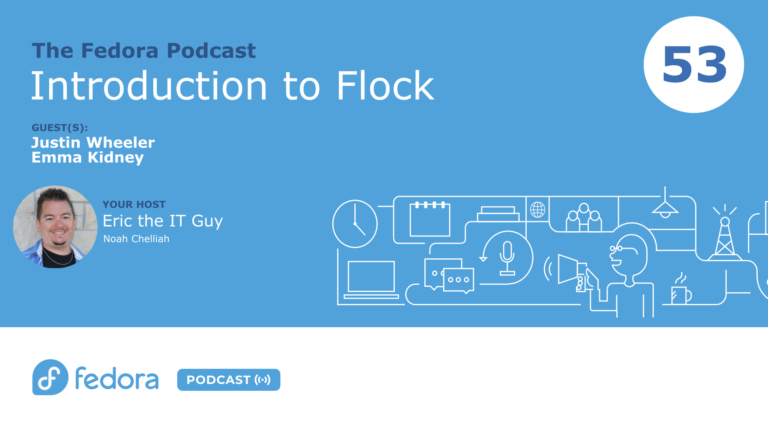
Introduction to Flock | Fedora Podcast 053

Flock to Fedora 2026: What to Expect in Prague

Flock to Fedora 2026 is heading back to Prague this June, and on episode 53 of the Fedora Podcast, Noah and I sat down with Justin Wheeler and Emma from the Fedora design team to talk through everything contributors and community members need to know.

For anyone who hasn’t been, Flock is the Fedora Project’s annual contributor conference — not a sales event, not a product launch, just the place where a global community of mostly volunteers gets together once a year to do real work, set direction, and remind themselves why they got into open source in the first place. Justin, who serves as Fedora Community Architect at Red Hat, described it well: it’s where you go to fuel up on the energy that carries you through the rest of the year. That tracks with my own experience. Some of the best conversations in open source happen at a table at midnight over bad food and good drinks.

The decision to return to Prague for a second consecutive year was a deliberate one. Travel anxiety into the US is real for a significant portion of the global Fedora community right now, and the Prague venue worked exceptionally well last year — accessible by train and plane, flexible space, and existing relationships with the hotel. Justin was transparent that this isn’t a new permanent model, just a practical call that let the team focus on improving the conference itself rather than rebuilding logistics from scratch in a new city.

The design theme for Flock 2026 is Alchemy, and Emma walked us through the research behind it. Prague’s history with alchemy traces back to Emperor Rudolph II, who brought Europe’s top alchemists to the city during his reign in the 1500s in pursuit of the philosopher’s stone. The design team ran a community vote on potential themes and alchemy won, which gave them a rich visual direction — medieval manuscripts, heraldic imagery, the Fedora four foundations rendered as elemental colors radiating from a stone. Fedora’s Flock mascot Kulora returns dressed as an alchemist this year, searching not for the philosopher’s stone but for Fedora itself. Emma is also reworking the design process to build a shared asset library so newer contributors can pick up design tickets without starting from a blank canvas.

As for the schedule: the conference runs June 14th through 16th, Sunday through Tuesday. Sunday is “Day Zero” — an offline workshop day with no AV and no plenary sessions, just hands-on working time for teams and SIGs to actually get things done face to face. Day One and Day Two follow a mirror structure: one opens with a single plenary track then breaks into three simultaneous recorded breakouts after lunch, the other does it in reverse. Both days will be live streamed so remote attendees can follow along. Registration is free, but you need to sign up in advance to get food, swag, and a conference t-shirt — and based on what Emma described about the alchemy branding, you’re going to want the t-shirt. Financial aid is also available for those who need it.

You can register now at fedoraproject.org/flock2026 and hang out in the #flock:fedoraproject.org room on Matrix if you have questions. Hope to see some of you in Prague.

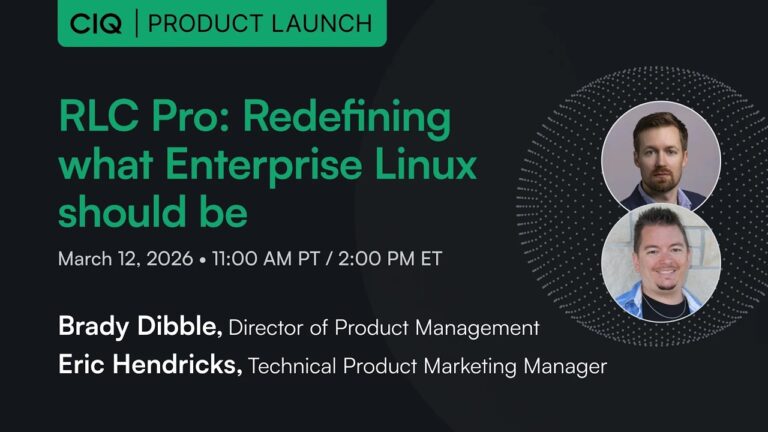
What Enterprise Linux Should Actually Be

What Enterprise Linux Support Actually Means (And Why It Matters)

Rocky Linux is everywhere, and for good reason. But community is not always enough, and this webinar is where Brady Dibble and I got into exactly what changes when you need a vendor behind your Linux stack.

Brady is CIQ’s director of product management and honestly one of the clearest thinkers I have talked to on the topic of enterprise Linux. We started at the 40,000 foot view: enterprises are not planning infrastructure in years, they are planning in decades. And that long-term stability calculus gets complicated fast when AI is forcing you to chase the latest kernel features and GPU support at the same time.

A big chunk of our conversation was about the difference between RLC Plus and RLC Pro, and when each one makes sense. RLC Plus is free, vendor-validated, and great for homelabs, startups, and anyone who needs more than community but is not running regulated production workloads. RLC Pro is where you get LTS, FIPS 140-3 compliant modules, indemnification, and actual support when things go sideways. Brady also made a point that stuck with me: you do not have to choose upfront. You can start on RLC Plus and move a node to Pro with basically a single command.

We also got into what indemnification actually means in practice, how FIPS compliance differs from FIPS certification, and why CIQ intentionally separated itself from the Rocky Linux project governance. That last one surprises a lot of people, and it came up at SCaLE just before we recorded this.

If you are running Linux in production or evaluating your options, this one is worth the watch. Subscribe to The IT Guy Show on YouTube and follow along at itguyeric.com for more.

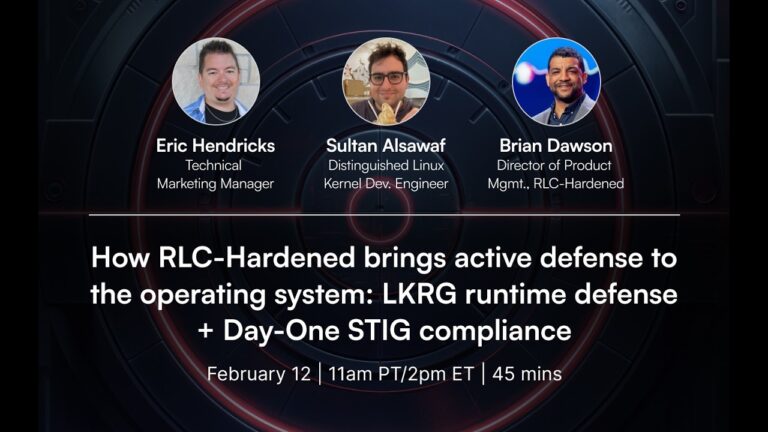
Active Linux Security with RLC Hardened and LKRG

Proactive Linux Security: How RLC Hardened Goes Beyond Patching

Reactive security is table stakes at this point, and it is not keeping up. I sat down with Nathan Blackham, Brady Dibble, and Sultan Alof from CIQ to talk about what it actually looks like to build defense into the operating system from day one.

The conversation started with something that hits close to home for anyone managing Linux at scale: CVE volume has exploded. The Linux kernel became its own CVE numbering authority a few years back, which means every commit gets evaluated for security relevance. That is good in theory, but in practice it means patching has become a near full-time job, and mission usually wins when you have to choose between a reboot window and keeping production up. Brady put it plainly: compliant and secure are not the same thing, and the gap between them is where things go wrong.

That is the whole premise behind RLC Hardened. It ships with a set of code-level changes designed to close off entire attack vectors before a CVE even exists for them. That includes a hardened glibc build, hardened malloc, tightened OpenSSH that drops the XZ library linkage after startup, stronger password hashing via yescrypt, and a few other targeted modifications. The gold image comes out at 95% STIG compliance on day one, which is an actual measured number, not marketing copy.

The standout piece is LKRG, the Linux Kernel Runtime Guard. Sultan walked through how it works and it is genuinely different from anything else in this space. Rather than scanning for known exploit signatures, it watches for the end goal of an exploit, things like a process claiming root credentials it never earned through legitimate channels. The demo showed it killing an exploit attempt cold, and the performance overhead is around 2.5%, which is low enough that most workloads will not notice it. It also ships signed for secure boot, which matters a lot in regulated environments.

If you are running Linux in production and security compliance is part of your world, this one is worth your time. Subscribe to The IT Guy Show on YouTube and follow along at itguyeric.com for more.

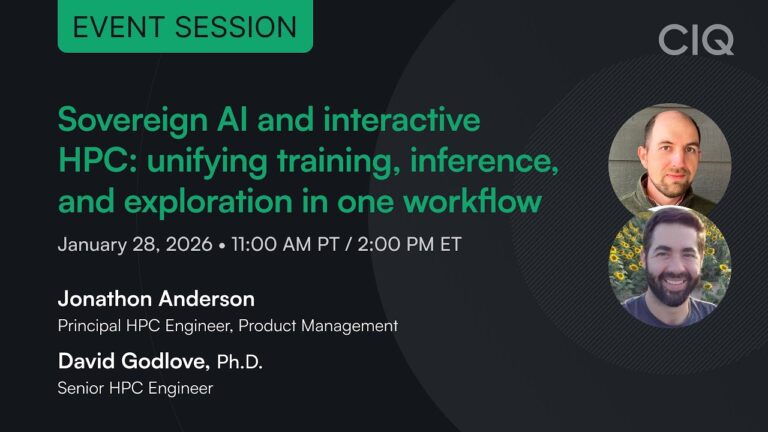
Soveriegn AI and HPC

Sovereign AI Infrastructure: Training, Inference, and Exploration in One Workflow

This was my first CIQ webinar and I walked away genuinely excited, which is not something I say lightly. Dave Godlove and Jonathan Sparks showed off Fuzzball’s new service endpoints feature and what it unlocks for teams that want to run their own AI without handing their data to someone else.

The core problem Jonathan laid out is something a lot of teams are quietly dealing with. Training, fine-tuning, building a RAG index, and running inference have traditionally been treated as completely separate workflows, often on separate tools. Fuzzball has always been a batch processing engine for HPC workloads, but service endpoints change the picture. Now a single workflow can include batch jobs that ingest and vectorize your documentation alongside a persistent AI service you can actually talk to, all managed through the same interface.

The demo Dave walked through made this concrete. Wolfgang (a colleague who built the workflow) set up a local AI stack inside Fuzzball that pulls documentation from a private GitHub repo, builds a vector database using local recall, and serves it through a RAG-enabled model you can query directly in the browser. No data leaves your environment. No external API calls. The model knew about Fuzzball because it had been trained on Fuzzball’s own docs, running entirely on CIQ’s infrastructure. Dave also showed off a virtual desktop service and a Jupyter notebook environment running through the same setup, both accessible with a single click from the web interface.

What got me was the scope controls. You can restrict a service to just yourself, share it with a team, or open it to your whole organization, and that applies to the AI model the same as anything else. The use cases kept expanding as we talked: internal documentation bots, sovereign coding assistants, VDI for remote research teams, agentic workflows connected to Slack or GitHub. All of it on hardware you control.

If you are curious what self-hosted AI actually looks like in practice, this one is worth your time. Subscribe to The IT Guy Show on YouTube and follow along at itguyeric.com.

Running an AI Locally | Live Ops 005

Run AI Locally on Fedora with Ollama: Live Ops 005

I wanted to run AI locally on Fedora using an Nvidia GPU I had sitting in my Dell PowerEdge R730 — and an hour and a half later, I actually got it working. Here’s what the road looked like.

The hardware is a Tesla K80, which is basically two 12GB VRAM cards in one chassis and cost me next to nothing off Amazon. The plan was straightforward: get the Nvidia drivers working on Fedora Server 41, pull down Ollama in a Podman container, add Open WebUI on top for a ChatGPT-like interface, and wire it all up behind NGINX Proxy Manager. I had notes. I had a cheat sheet. I was ready.

What I wasn’t ready for was Fedora’s relationship with Nvidia drivers. The Tesla K80 needs the 470.xx legacy driver, not the current one, and figuring that out took most of the first hour. Between installing the wrong driver version, conflicts with packages left over from previous attempts, and the driver service not loading cleanly, it took a force rebuild of akmods and dracut before nvidia-smi finally came back with output. AMD cards just work. Nvidia is a project.

Once the GPU was cooperating, getting Ollama running locally turned out to be easier than the container approach I’d planned, since the GCR image path for the Podman version kept returning errors. Ollama installed directly on the host, Llama 3.2 pulled down without complaint, and I had a working local model to talk to inside of a few minutes. DeepSeek R1 8B came along for the ride as a second model to compare. Open WebUI came up in a Podman container, and after a solid round of “why won’t this connect,” the fix turned out to be a single :Z flag on the volume mount — SELinux doing what SELinux does.

By the end of the stream, Open WebUI was running, both models were loaded, and I had a local AI setup I could actually use. The NGINX reverse proxy was still showing a bad gateway when I had to call it for the day, but that’s a problem for next session. On the to-do list: get RAG working so I can feed it my own blog posts as a local knowledge base, and eventually stop paying OpenAI for what I can run at home.

Watch the full stream above, and if you want to follow along as the homelab build continues, subscribe to the channel or grab the audio version of the main show at podcast.itguyeric.com.

Building a Golden Image | Live Ops 004

Building a Golden Image | Live Ops 003

The goal was simple: build a reusable Fedora golden image homelab template I can clone whenever I need a new server. Nothing about it was simple.

The plan was to use Image Builder inside Cockpit to create a base Fedora server image, then store the resulting QCOW2 file on my unRAID box so I can spin up new VMs on demand. I had packages already lined up in the blueprint: Crony, Cockpit, NetworkManager, bash completion, VIM enhanced, TuneD, and a few others. The Ansible service account was configured, IPv6 disabled at the kernel level, and automatic partitioning set so I’m not hand-holding every deployment. It was supposed to be a quick stream before the Fedora podcast.

What actually happened was a solid hour of fighting permissions issues with the welder group, a blueprint package that didn’t exist in Fedora the way it does in RHEL, and Image Builder refusing to build ISO images while happily producing QCOW2 files without complaint. Once I got the QCOW2 built and pulled down, I had to convert it to an IMG file using qemu-img convert just to get unRAID to accept it, then resize the image to 32 gigs because the VM came up with a 4.2 gig root partition and nowhere to grow. ext4 on an unRAID VM turned out to be less cooperative than I’d hoped.

The good news: by the end of the stream I had a booting Fedora VM with bash completion, VIM enhanced, and Cockpit already running, SSH keys in place, and the performance profile defaulted to virtual-guest automatically. The less good news: I’m probably moving VM deployment over to my Fedora-based ITG02 hypervisor from Live Ops 003, where QCOW2 management is a lot less painful. The Ansible playbook to automate the whole build-convert-deploy pipeline is the next piece, and that’s where things should start getting cleaner.

Watch the full stream above, and if you want to follow along as the homelab build continues, subscribe to the channel or grab the audio version of the main show at podcast.itguyeric.com.

RHEL as a Hypervisor | Live Ops 003

RHEL Hypervisor Homelab Setup: Live Ops 003

A Dell PowerEdge R730 that’s been sitting in the rack collecting dust finally has a job: and this stream is the whole messy process of giving it one.

The goal was straightforward: install RHEL 8 on bare metal and get the R730 running as a RHEL hypervisor homelab host. But rather than just grabbing a stock ISO, I went straight to Red Hat Image Builder on console.redhat.com, because if you spent years doing TPMM work for RHEL, you use Image Builder. The hosted build queue had other ideas though, and what should have taken a few minutes turned into a 40-minute wait that only resolved after I kicked off a second build to shame the first one into finishing.

Once the ISO was finally in hand, getting the Dell to actually boot from it proved to be its own adventure. Wrong boot order, a RAM upgrade the server needed a moment to accept, and the classic “it wasn’t broken, just needed more time to transfer over the network” diagnosis courtesy of guest heckler Nate, the Iron Sysadmin. The install itself went smoothly once RHEL 8.10 got its turn: custom partitioning, a dedicated Ansible service account, kdump disabled, and TuneD set to virtual-host profile so the system optimizes for running VMs rather than general workloads.

After the install, I wired the box into Red Hat Insights, which is included with any RHEL subscription and immediately flagged a handful of advisories, two of which were auto-remediable via an Ansible playbook without ever leaving the Insights UI. Cockpit got enabled, the virtualization host package group went in, and I spun up a test VM to confirm everything was working. I wrapped the stream with a local Image Builder instance installed on the hypervisor itself, laying the groundwork for generating golden VM templates for Fedora, CentOS Stream, and RHEL without depending on the hosted service.

Watch the full stream above, and if you want to follow along as the homelab build continues, subscribe to the channel or grab the audio version of the main show at podcast.itguyeric.com.

WordPress Migration | Live Ops 002

WordPress Migration to Homelab: Live Ops 002

The WordPress migration homelab project that started as a quick detour turned into a two-hour deep dive — because nothing in the homelab ever goes exactly to plan.

If you caught Live Ops 001, you know we got the Matrix server almost running — right up until an SSL certificate issue stopped us cold. The problem? itguyeric.com was hosted on Namecheap’s EasyWP platform, which doesn’t let you export your own certificates. The fix was obvious: move the site home. And with a $94 renewal coming up in about a week, there was really no reason not to.

The plan was to spin up a fresh Fedora server VM, deploy WordPress in a Podman container, migrate the site using the All-in-One WP Migration plugin, and wire it all up behind NGINX Proxy Manager with a Let’s Encrypt cert that covers both itguyeric.com and matrix.itguyeric.com. Clean, tidy, two birds one stone. In practice: wrong ISO architecture, a MariaDB port conflict, a file permissions hang, and a Matrix federation API that kept failing despite the federation tester saying everything was fine. Classic.

By the end of the stream, WordPress was running locally and the Matrix server was showing green check marks on the self-check — but federation between accounts still wasn’t cooperating. Eric called it to go take care of family, with a promise to sort out the remaining certificate and domain config issues in a follow-up.

The WordPress migration homelab journey continues — subscribe so you don’t miss Live Ops 003 when it drops. Audio version of the main show is always at podcast.itguyeric.com.

Matrix Server Rebuild | Live Ops 001

Self-Hosted Matrix Server Rebuild: Live Ops 001

I fired up a livestream to do something I’ve been putting off way too long: bringing my self-hosted Matrix server back from the dead, live, in real time, with no safety net.

The stream started simple enough — spin up a fresh VM, throw CentOS 7 on it to match the original environment (don’t @ me), and use the Matrix Docker Ansible Deploy project to get everything running again. The goal was straightforward: restore the old setup, get the Matrix bridges reconnected to Discord and Slack, and then figure out how to modernize the whole thing on something like Fedora or even OpenShift down the road.

What actually happened was a four-plus-hour deep dive into DNS records, SSL certificate headaches, and Namecheap doing Namecheap things. By the end, federation checks were almost passing — but a CNAME where an A record needed to be, and a certificate tied to a shared hosting account I couldn’t extract cleanly, kept the finish line just out of reach. Classic homelab energy.

The good news: the Matrix server itself was provisioned, configured, and responding. The bad news: itguyeric.com’s WordPress site is hosted via Namecheap EasyWP, which doesn’t let you pull your own certs — so the next logical step is migrating the WordPress site home and tackling the SSL setup properly.

If you’re running your own Matrix homeserver or thinking about it, this stream is a pretty honest look at what that process actually involves — including the parts that go sideways. No polished edits, no second takes.

Watch the full stream above, and if you want to follow along in real time next time, join the IT Guy Show room on Matrix or hop into the Discord. You can also subscribe to the audio version of the main show at podcast.itguyeric.com.

I have loved video games my entire life. I got started on a Super Nintendo playing Super Mario Brothers and Super Mario Kart. That was the start of my #nerdlife. Haha!

It was great to sit down with Matt and talk D&D and play Terminator as part of my prep for a podcast. Not very often can you say leveling up is part of your show prep.

On this episode of Game Sphere I get the chance to talk with Eric from the Sudo Show. We talk a bit of DND and then we get into talking about Terminator Salvation and our first impressions of it after playing for a few hours.

Rocco was one of the people I instantly connected with in the open source community. His values and his love of the people in open source really resonated with me. Rocco really helped encourage me while finding my own voice.

We talked a LOT on this episode! We covered things from gaming to conferences to announcing the launch of the Sudo Show podcast!

In today’s episode of Linux Spotlight, I get to sit down with my friend Eric The IT Guy. Eric has been in the IT field for awhile and currently works for RedHat. We talk about his history in Linux, his job, Linux conferences and his new podcast called the “Sudo Show”.

We got a single test episode before going back to the drawing board. After months of networking, planning, seeing what else is out there, we settled on a great approach that we feel will be unique and can make a difference in IT and how technologists do work.

Some time ago, our favorite IT Guy published a couple of test episodes. Its funny to look back at these episodes in light of the upcoming release of The IT Guy podcast!

Waaaaay back on Episode 26 of the Ask Noah Show, The IT Guy was being formed an molded. Now, a little over a year later, we are getting ready to launch our brand, our podcast, and our efforts to help shape how the open source community does work!

I got to join Noah Chelliah on the Ask Noah Show to continue my coverage of Peertube. It was a great chat, took a couple of calls, and found a toy I really want from Paravel Systems: The Rivendell Audio Appliance!