CIQ Portal

CIQ Portal Is Live: Access and Deploy CIQ Products on Your Own Terms

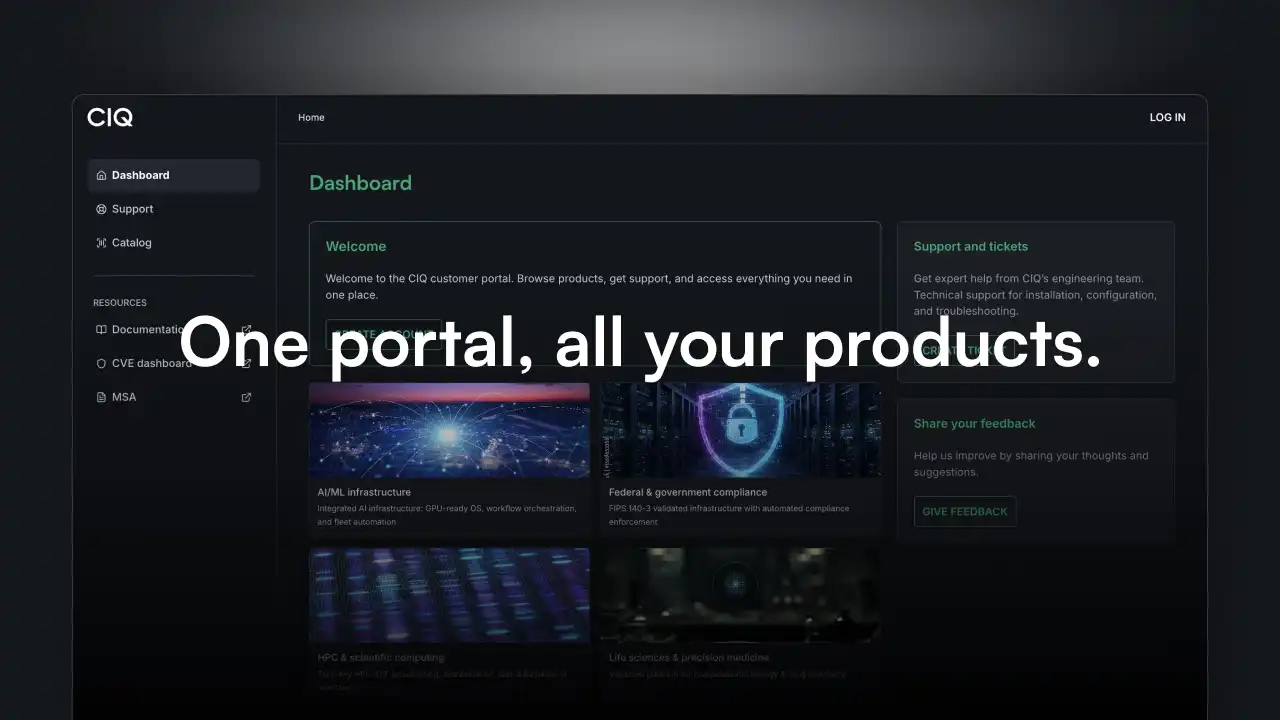
I wrote the launch post announcing the CIQ portal going live at portal.ciq.com, covering what it is, who it’s for, and how to go from registration to your first download in under a minute.

The portal is the central hub for everything CIQ: product downloads, license keys, documentation, and team permission management across the full portfolio. That includes RLC Pro, RLC Pro Hardened, RLC Pro AI, RLC+, CIQ Bridge, Fuzzball, Ascender Pro, and Warewulf Pro. The post walks through the catalog structure, the Solution Stacks view for teams who aren’t sure where to start, and a step-by-step example deploying RLC Pro AI for a sovereign AI workload in a private data center.

One thing I wanted to get across was how genuinely fast the self-service flow is. Free tier, 30-day trial, or full enterprise deployment, you can get moving without talking to anyone first.

Read the full post on CIQ: The CIQ Portal Is Live

Product accessibility is something I care about, and this post was a good opportunity to show how a well-designed portal can lower the barrier to evaluating enterprise infrastructure software.
Migrate to RLC Pro

How to Migrate from RHEL to RLC Pro Without Re-Architecting

I wrote this guide for CIQ covering how to convert a running RHEL system to RLC Pro, without rebuilding servers or re-certifying your application stack.

The core of the post is Enterprise Linux binary compatibility. Because Rocky Linux builds from the same source RPMs as RHEL, the kernel ABI stays stable, shared libraries match, and your applications, Ansible playbooks, and automation carry over without modification. What actually changes is repository URLs, package signatures, and OS branding. That’s it. The migrate2rlc script handles the conversion on a live system, and the post walks through the full process: environment assessment, collecting CIQ portal credentials, running the migration, and validating the result.

I also covered what you get on the other side. LTS version pinning, FIPS 140-3 validated packages on the .2/.6/.10 releases, commercial support tiers, and IP indemnification. The migration is the starting point, not the finish line.

Read the full post on CIQ: How to Migrate from RHEL to RLC Pro Without Re-Architecting

Migration content sits at the intersection of technical depth and business case, which is the kind of writing I enjoy most and where my sysadmin background actually earns its keep.

Trip Report: SCaLE

CIQ at SCaLE 23x: Trip Report

I co-wrote this recap with Michael Young and R. Leigh Hennig covering CIQ’s presence at SCaLE 23x in Pasadena, and I was there in person as a speaker.

The post covers the full picture: 300+ badge scans at the CIQ booth, conversations with folks from Microsoft, Meta, Fedora, Red Hat, AlmaLinux, RESF, and more, a sponsored hardening workshop, and Community Game Night where Michael and I got absolutely dismantled at Uno No Mercy. The Asterisk community connection was an interesting thread too, with real follow-up conversations about adding Rocky Linux as a supported distribution.

My contribution to the program was a talk called “From Bash to Burnout: Staying Sane in a 24/7 Tech World.” It was a personal one. Behind every uptime badge is a tired sysadmin, and I wanted to have an honest conversation about protecting your time and energy without losing your love for the work. It drew about 20 to 30 attendees and sparked some good discussion afterward.

Read the full post on CIQ: CIQ at SCaLE 23x Trip Report

Burnout in tech is something I have thought about for a long time, and getting to talk about it in front of a room full of sysadmins and infrastructure people at SCaLE felt like exactly the right venue.

What Enterprise Linux Should Actually Be

What Enterprise Linux Support Actually Means (And Why It Matters)

Rocky Linux is everywhere, and for good reason. But community is not always enough, and this webinar is where Brady Dibble and I got into exactly what changes when you need a vendor behind your Linux stack.

Brady is CIQ’s director of product management and honestly one of the clearest thinkers I have talked to on the topic of enterprise Linux. We started at the 40,000 foot view: enterprises are not planning infrastructure in years, they are planning in decades. And that long-term stability calculus gets complicated fast when AI is forcing you to chase the latest kernel features and GPU support at the same time.

A big chunk of our conversation was about the difference between RLC Plus and RLC Pro, and when each one makes sense. RLC Plus is free, vendor-validated, and great for homelabs, startups, and anyone who needs more than community but is not running regulated production workloads. RLC Pro is where you get LTS, FIPS 140-3 compliant modules, indemnification, and actual support when things go sideways. Brady also made a point that stuck with me: you do not have to choose upfront. You can start on RLC Plus and move a node to Pro with basically a single command.

We also got into what indemnification actually means in practice, how FIPS compliance differs from FIPS certification, and why CIQ intentionally separated itself from the Rocky Linux project governance. That last one surprises a lot of people, and it came up at SCaLE just before we recorded this.

If you are running Linux in production or evaluating your options, this one is worth the watch. Subscribe to The IT Guy Show on YouTube and follow along at itguyeric.com for more.

Tech Burnout Recovery: What I Shared at SCaLE 23

This one was personal. I gave this talk at SCaLE 23 in Pasadena as part of Open Source Career Day, and I will be honest, I almost did not write it because it meant putting some very uncomfortable things on a slide.

In 2025 I lost a job I had held for five and a half years in a seven-minute call. Over the next 96 days I worked overnight shifts at a gas station, interviewed on no sleep during what should have been my sleep hours, and spent a lot of time figuring out who I was when the job that had become my identity was gone. I also said yes to teaching Linux administration at Johnson County Community College, which I almost turned down, and eventually landed at CIQ. Both of those came through my network, not job boards.

The talk covers what burnout actually looks like before you realize you are in it, the patterns that get technical people there faster than most, and some practical steps I used to stabilize and rebuild. I talk about the hero trap, context switching, the identity trap, and what a blameless postmortem on my own situation taught me. There is also a question I started asking people in my life that has saved me more arguments than I can count, and I share it in the talk because it is genuinely that useful.

This is not a polished keynote. The slide deck had some technical issues live, I was processing some heavy personal news the morning of the talk, and it shows. But I think that is part of why it landed the way it did.

Watch the full talk on YouTube: From Bash to Burnout | SCaLE 23 Open Source Career Day

Sustainability is one of the most important skills you can build in this industry. Reliability requires maintenance, and that applies to people too.

SCaLE - Bash to Burnout

From Bash to Burnout: My SCaLE 23x Talk

I gave this talk at SCaLE 23x in Pasadena as part of Open Source Career Day, and it is probably the most personal thing I have ever put on a stage.

2025 was a hard year. I lost a job I had tied my entire identity to, spent 96 days working overnight shifts at a gas station, and went through some personal upheaval I was not prepared for. I did not plan to turn any of that into a conference talk. But when I was asked to speak, it felt dishonest to stand up in front of a room full of sysadmins and IT folks and pretend I had it all figured out.

The talk covers what burnout actually looks like before you realize it is happening, the patterns that lead there, the signals I missed in my own life, and some practical things that genuinely helped. Not productivity hacks. Real stuff, like building a daily rhythm when everything falls apart, maintaining a few relationships with no agenda, and learning to separate your identity from your employer before a reorg does it for you.

I also talk about what I did right after the layoff and what I would do differently. Spoiler: I should have taken time to grieve before immediately hunting for the next thing.

If any of this sounds familiar, the recording is worth 40 minutes of your time.

Burnout is not a personal failing. It is a warning sign. I needed someone to say that to me in 2025, so I figured I would say it to a room full of people instead.