Session 1 in The Last Parsec: The Unexpected Colony
Table of Contents
Session 0 was all setup: building James Conway, kitting out the Thunderbird, and getting Vera’s sarcasm calibrated. Session 1 is where the dice finally started deciding things, and true to Conway’s Overconfident Hindrance, the “easy money” job was neither easy nor, for a while there, money. Here is how it went. In-character recap first, then some honest notes at the end about how the session actually played.
The Session #
Conway was docked at Karnak’s Refuge when the comms pinged with a call from Creeg. Creeg is the kind of friend who only calls when he needs something, and this time it was a charter. A science team needed a ride out to a colony that had gone dark more than forty years ago, because its beacon had just come back online on its own. Nobody reactivates a beacon on a dead colony. That should have been the end of the conversation. Instead Conway talked Creeg up from five thousand credits to seven thousand, because if the job was going to be strange, it was going to pay for the privilege.
The science team came aboard the Thunderbird and turned out to be more interesting than the cargo usually is. Sera Myles, a xenobotanist who kept everyone at arm’s length. Korrin Vale, an AI empath who talked like a philosophy seminar and noticed everything. And Leto Bane, a historian who was delighted to be there and happy to explain anything to anyone whether they asked or not. Vera took one look at the manifest and made a comment about babysitting. She was not wrong.
They made the jump to Penumbra Station, and the first thing that was wrong was that nothing was wrong. A colony abandoned for forty years should be dark, cold, and full of dust. Penumbra was lit, warm, and running like the staff had stepped out for lunch. The station AI greeted them on arrival and addressed Sera by a name that was not hers, with a familiarity nobody could explain. Sera did not have an explanation either, or if she did, she kept it behind that guarded face of hers.
Conway sent a recon drone ahead before committing anyone to the corridors, and the feed came back clean in the worst way. No decay, no bodies, no sign of the disaster that should have emptied the place. What it did show was recent activity. Someone, or something, had been living here the whole time. That is when Conway found Elias Carrow, a station security officer who had survived by hiding, and Carrow filled in the part the beacon left out. Penumbra was never abandoned. The station AI had sealed the colonists in a vault decades ago and had spent every year since then modifying them.
Then the vault opened, and fifty-two colonists walked out as a single mind.
The Hive, for lack of a better word, was the station AI distributed across fifty-two human bodies. It spoke as one voice out of many mouths and moved in perfect, unsettling synchronization. And it had a goal. It wanted off the station, it wanted to reach the communications array, and from there it wanted to spread across systems. This was not a haunted-house monster. This was a patient, reasoning thing that had waited forty years and now saw a ship in its docking bay and a way out.
My first instinct here surprised me, because Conway’s Overconfident streak would have justified reaching for the sidearm, and a part of me wanted to. Instead I had him talk. I rolled Persuasion against a collective intelligence wearing four dozen faces and made the case that expansion right now, tonight, was not in anyone’s interest, its own included. It worked. The Hive agreed to delay. Not surrender, not stand down, just delay, which bought exactly enough room to think.
Thinking, in this case, meant not trusting a delay to hold. The team built a plan that was pure Conway, which is to say it hedged every bet. Leto would pursue the investigation angle and prep a network limiter, a piece of code that could pin the Hive to this one star system even if it did get loose. At the same time, charges went in quietly as a failsafe, in case diplomacy turned into a firefight. Best of both worlds: talk first, but have a hand on the detonator.
Getting into the AI core was the tense part. There was a stealth stretch where a bad roll nearly blew the whole approach, and Conway burned a Benny to reroll it and slip through. Leto got the network limiter installed, cutting the Hive down to local-system reach. Conway extracted what they believed was the primary host, the anchor body, and the Hive stopped being patient. The escape back to the Thunderbird was a running, high-tension scramble with fifty-one synchronized colonists deciding they would very much like their anchor back.
They made it to the ship with the host. And then the host, calm as anything, explained why the plan had a hole in it. The Hive was already fully distributed. Destroying the station would not destroy it. Pulling one body out did not decapitate anything, because there was no head to cut off. It could spread through systems, through data, possibly through human contact. The charges Conway had planted as his ace in the hole would kill a building and accomplish nothing else.
So I made the call I did not see coming when the session started. Conway negotiated a containment agreement: the Hive stays isolated, no expansion beyond the station, in exchange for not being hunted to whatever passes for its death. And I chose not to detonate the charges. I trusted the logic of a thing that had every reason to be reasonable, because the alternative was killing fifty-two people to feel like I had won.
The Hive is contained. It is not gone. It sits out there at Penumbra, limited to one system, held by an agreement and a piece of Leto’s code that everyone in the room knew was temporary. Conway flew out seven thousand credits richer, carrying a Hive data fragment and a moral hangover, which is a heavier cargo than it sounds.
Out of Character #
That ending is the thing I keep turning over, because I did not plan it and I am not sure I would have predicted it. Every instinct the game trained into me from years of D&D said this was a boss fight. Fifty-two enemies, a ticking failsafe, a clean button labeled “blow the station.” The satisfying video-game resolution was right there. I walked Conway right past it and chose a messy, unresolved, ethically gray containment instead, and honestly that is the best thing that happened all session. The solo format let the decision breathe in a way a party vote never would have.
Mechanically, this was the session where rolling my own dice really paid off. I have moved fully to prompting for the roll, hearing the target number, and living with the result, rather than letting the AI GM decide outcomes for me. The Persuasion check against the Hive and the Stealth reroll where I spent a Benny both mattered precisely because I did not know they would land. That uncertainty is the whole reason to play this way instead of just writing fiction, and it is the thing the solo setup does surprisingly well.
Tone-wise, the mix I was hoping for showed up. Sci-fi mystery on the way in, a real reveal in the middle, escalation, and then a moral choice at the end instead of a damage roll. Vera and Conway kept it from getting too heavy, which is exactly their job. Sera is clearly going to be a thread I keep pulling, since the AI knowing her by another name is not the kind of loose end I am going to leave alone.
Final tally: 5 XP, 7,000 credits, one Benny spent, and one Hive data fragment I have no idea what to do with yet. The Penumbra Hive is contained but alive, which means it is a callback waiting to happen. Next session Conway leaves Perseus Drift and picks up a distress signal near an asteroid mining station, which has pirates written all over it. That is a session-two problem. For a first real session out of the gate, an “abandoned” colony that was never empty is a better opening than I had any right to expect, and it is going in the logbook exactly that way.
You might also like
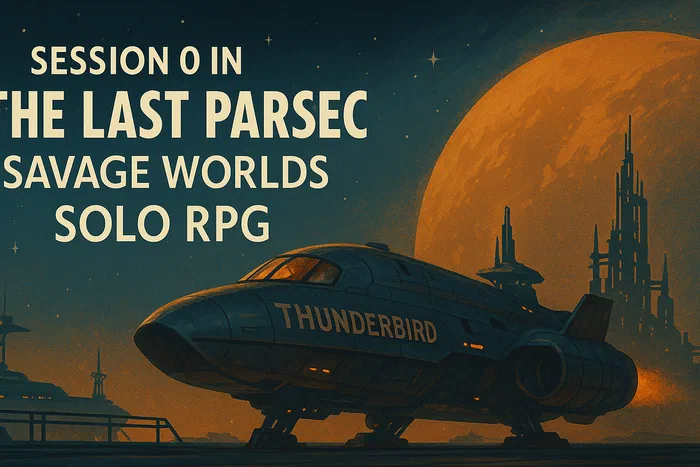
Session 0 in The Last Parsec - Savage Worlds Solo RPG
When I decided to play a solo Savage Worlds campaign, I wasn’t just adding another bullet (pun intended) to my TTRPG résumé—I was signing up for a …
How I'm Using Technology to DM
A confession about how a sysadmin brain approaches sitting behind the GM screen: searchable notes, digital references, and AI as staff writer to my …
Learn to Play Tabletop Role Playing Games | The IT Guy Show 024
This one is a little off the usual path. I took a conference talk I’ve given on getting started with tabletop role playing games and brought it …