Event-driven Infrastructure with Ansible | RHEL Presents Ep. 69
For episode 69 my cohost Brian Smith and I welcomed back Nuno Martins, a principal technical marketing manager on the Ansible business unit, who last joined us on episode 47 for an intro to Ansible Automation Platform. This time we picked up where automation usually stops: instead of you running a playbook, we talk about how the platform can listen for events and respond on its own. It was a fun one to record between a wall of livestreams and the recent RHEL 9.3 launch.
A few things worth carrying away from the conversation:
- Event-Driven Ansible flips automation from something you trigger to something that triggers itself. Rather than logging in to run a playbook when something breaks, you let sources feed events in and let rules decide what runs.
- This builds on Ansible Automation Platform, not around it. Nuno framed event-driven work as an extension of the same automation foundation we covered back on episode 47, so the skills you already have carry forward.
- If you want the fundamentals first, start with the intro. We pointed folks back to Nuno’s earlier episode for the elevator pitch on what Ansible Automation Platform is and what it’s trying to solve before layering event-driven ideas on top.
If you’ve been automating tasks but still babysitting the alerts, this episode is a good nudge toward closing that loop.
You might also like
Building a Linux Community with Noah Chelliah | RHEL Presents Ep. 82
A companion to RHEL Presents episode 82, where Nate and I talk with Noah Chelliah about community, careers, and getting people on-ramped into open …
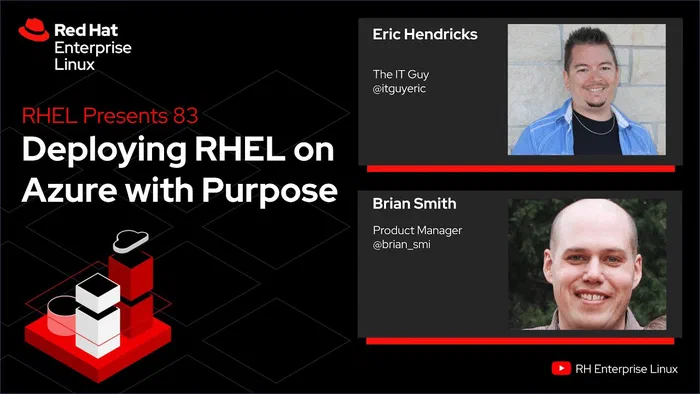
Deploying RHEL with Ansible Automation Platform | RHEL Presents Ep. 83
In my last episode as host, Brian and I bring on three guests to demo a full GitOps pipeline deploying and testing RHEL workloads on Azure with …

A Day in the Life of a Solutions Architect | RHEL Presents Ep. 73
Chuck Marshall joins Brian and me to walk through what an account solution architect really does day to day across RHEL, Ansible, and OpenShift.